Business & Entrepreneurship • Story 2 • 12 min read
A Story About Opportunity, Creative Thinking, and the Question That Changed Everything

Many opportunities die not because resources are unavailable, but because people assume resources must come from only one source.
When conventional pathways close, wise problem-solvers ask a different question:
“Who else has an interest in seeing this succeed?”
That question often reveals opportunities hidden in plain sight.
The phone call came with excitement and anxiety wrapped together.
A businessman had secured a major purchase order for highly specialized electronic equipment.
Winning the order should have been a breakthrough moment.
Instead, it became a crisis.
The equipment had already been identified.
The supplier existed.
The specifications were known.
The customer was ready.
The opportunity was real.
There was only one problem.
The funding did not exist.
The amount required was significant—far beyond what the businessman could raise on his own.
The obvious solution was to approach the banks.
So he did.
The response was disappointing.
One institution after another declined.
Some felt the transaction was too large.
Others considered it too risky.
A few simply said no.
As the weeks passed, the opportunity began slipping away.
Without funding, there would be no purchase.
Without the purchase, there would be no delivery.
Without delivery, there would be no project.
The contract that had promised so much now seemed destined to become another story about what might have been.
The situation appeared straightforward.
The challenge was funding.
The solution therefore had to be money.
That was the assumption.
And assumptions can become invisible prisons.
Everyone was looking in the same direction.
Everyone was asking the same question:
“How do we get the money?”
The more people focused on that question, the more impossible the situation appeared.
Yet hidden inside every difficult challenge is another question waiting to be asked.
Sometimes the breakthrough does not come from finding a better answer.
Sometimes it comes from asking a better question.
Instead of asking:
“How do we get the funding?”
Another question emerged:
“Who else benefits if this project succeeds?”
The customer benefited.
The businessman benefited.
The supplier benefited.
The manufacturer benefited.
The entire transaction depended on all parties succeeding together.
That realization opened a completely different line of thinking.
If the banks were unwilling to participate, perhaps the supplier could become part of the solution.
The idea sounded unrealistic.
Some considered it impossible.
Why would an international manufacturer release equipment worth millions of dollars without receiving payment upfront?
Industry practice suggested it would never happen.
Conventional wisdom said not to waste time pursuing such an idea.
But problem-solvers understand something important:
A possibility does not become impossible simply because it is unusual.
Rather than debating the idea endlessly, action was taken.
A meeting was arranged.
A journey began.
The destination was Switzerland.
The goal was simple:
No guarantees existed.
No promises had been made.
No outcome was certain.
Yet there are moments in life when progress requires the courage to knock on a door that others assume will remain closed.
The discussions were detailed.
The opportunity was explained.
The project was reviewed.
The risks were examined.
The potential benefits were considered.
Trust began to develop.
What happened next surprised almost everyone involved.
The supplier agreed.
More than two million dollars worth of equipment was approved for supplier credit.
No conventional financing.
No established borrowing arrangement.
No traditional funding structure.
The equipment was manufactured.
The shipment was released.
The project moved forward.
The customer received the solution they needed.
The businessman fulfilled the contract.
The supplier gained a new relationship.
What had appeared impossible only weeks earlier became reality.
Not because money suddenly appeared.
Not because circumstances changed.
Not because the banks changed their minds.
The breakthrough happened because somebody was willing to explore a pathway others had never considered.
Most people focus on visible obstacles.
Wise problem-solvers look for hidden opportunities.
This pattern repeats itself in businesses, ministries, organizations, communities, and even nations.
Many struggles remain unresolved because everyone is attempting to solve them in the same way.
Transformation often begins when someone has the courage to think differently.
Identify the visible challenge. What is happening?
Challenge assumptions. What am I assuming must happen?
Identify all stakeholders. Who benefits if this succeeds?
Consider unconventional pathways. What alternatives have not been examined?
Start conversations. Who needs to be involved?
Take action. Test the opportunity.
Apply the lesson elsewhere. What did this experience teach me?
What exactly is preventing progress?
Who benefits if this problem is solved?
What have you accepted as fixed that may not actually be fixed?
What option have you not seriously considered?
Many breakthroughs begin with a conversation that never happened.
Make the call.
Send the message.
Schedule the meeting.
Knock on the door.
Throughout Scripture, God repeatedly worked through situations that appeared impossible.
Moses stood before a sea.
Nehemiah faced ruined walls.
David confronted a giant.
The disciples faced thousands of hungry people with almost no food.
The obstacle was real.
The challenge was genuine.
Yet God often revealed solutions that nobody expected.
Faith is not denying reality.
Faith is believing that reality may contain possibilities we have not yet seen.
Many breakthroughs begin when we stop focusing exclusively on what is missing and start paying attention to what God has already placed within reach.
Some challenges require more than information. They require strategy, fresh thinking, and implementation.
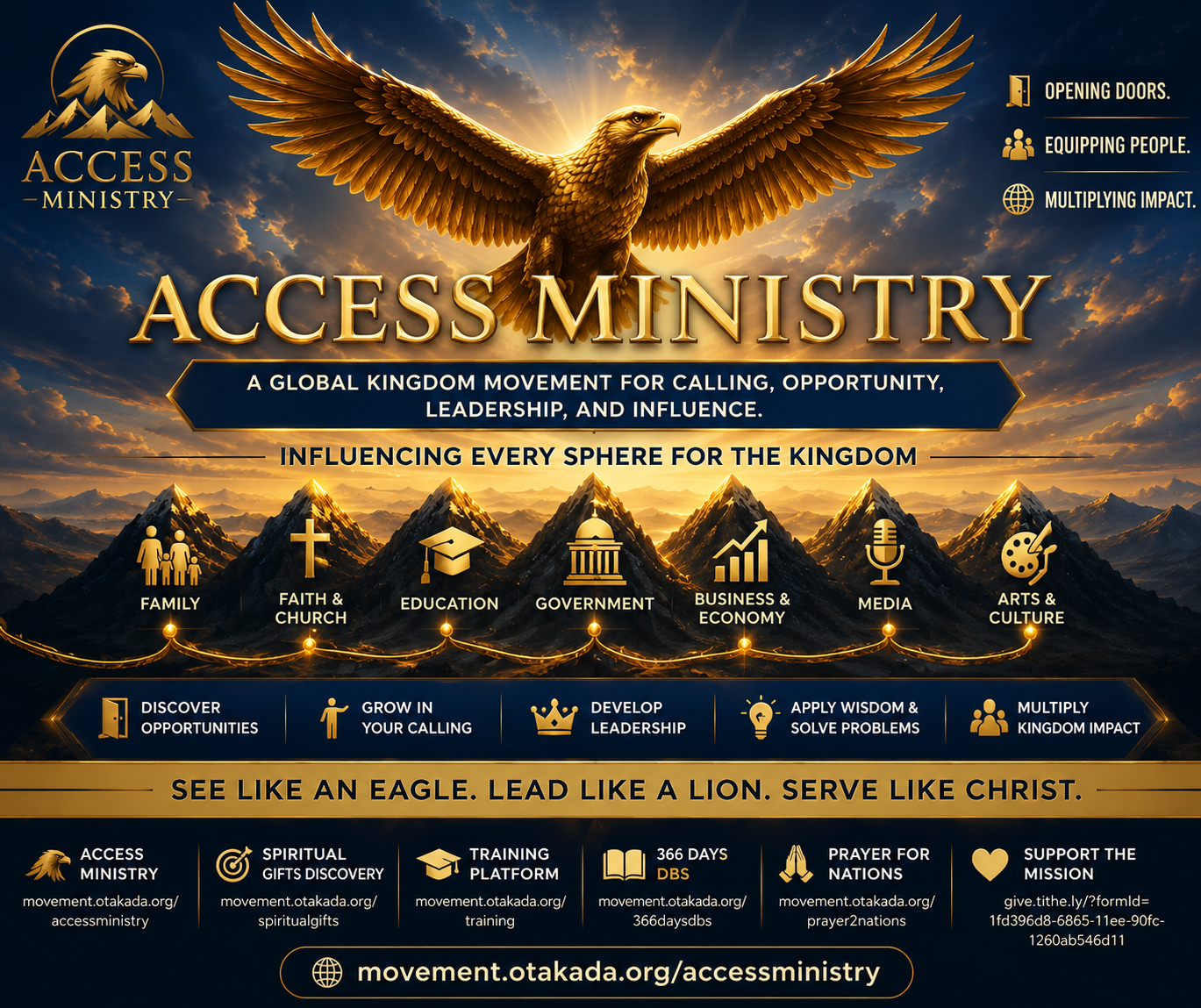
God’s Eagle Access Ministry helps individuals, families, ministries, businesses, organizations, and nations solve complex challenges and discover practical pathways forward.
Information helps.
Implementation transforms.
👉 Join the Access Ministry Community
👉 Join the Newsletter / Community
👉 Join the WhatsApp Intercessory Community
🦅 Access Ministry — Opening Doors. Equipping People. Multiplying Kingdom Impact.
🎯 Spiritual Gifts Discovery — Discover how God uniquely designed you.
🎓 Movement Training — Develop practical skills for life, leadership, ministry, and influence.
📖 366 Days DBS — Develop a daily rhythm of Scripture, obedience, and disciple-making.
🙏 Prayer for Nations — Join believers praying for nations, leaders, and global transformation.
🛒 Bookstore — Explore books, devotionals, and discipleship resources.
Opening Doors.
Equipping People.
Multiplying Kingdom Impact.
Because sometimes the breakthrough is not finding more resources.
Sometimes the breakthrough is discovering a pathway that others never thought to explore.
Curated Stories designed to help you discover opportunities, strengthen your calling, develop practical skills, increase influence, and create Kingdom impact in your sphere of assignment.

Business & Entrepreneurship • Story 2 • 12 min read THE ORDER NOBODY COULD FINANCE A Story About Opportunity, Creative Thinking, and the Question That Changed Everything ACCESS PRINCIPLE Many opportunities die not because resources are unavailable, but because people assume resources must come from only one source. When conventional pathways close, wise problem-solvers ask […]
Read
THE DAY SARAH REALIZED THE PHONE WASN’T THE PROBLEM A Story About Screen Time, Connection, and the Question That Changed Everything ACCESS PRINCIPLE Children rarely abandon what meets a need until something better replaces it. Many parents focus on removing behavior. Wise parents focus on understanding what the behavior provides. When we address the deeper […]
Read
Access Ministry Opening Doors. Equipping People. Multiplying Impact. Many people think ministry only happens behind pulpits, inside church buildings, during crusades, or within religious gatherings. But Scripture reveals that God has always used access points to reach people, transform lives, influence nations, and reveal His purpose. 👑 Leadership God uses leaders with wisdom, discipline, integrity, […]
Read
🦅 ACCESS MINISTRY Opening Doors. Equipping People. Multiplying Impact. A global Kingdom movement for calling, opportunity, leadership, innovation, service, discipleship, and influence across every sphere of society. Why Access Ministry Exists Many people think ministry only happens behind pulpits, inside church buildings, during crusades, or within religious gatherings. But throughout Scripture, God used ordinary people […]
Read